Used by Multi-Supplier Dropshipping Businesses  

Are You Struggling to Scale Your Multi-Supplier Ecommerce Operations?


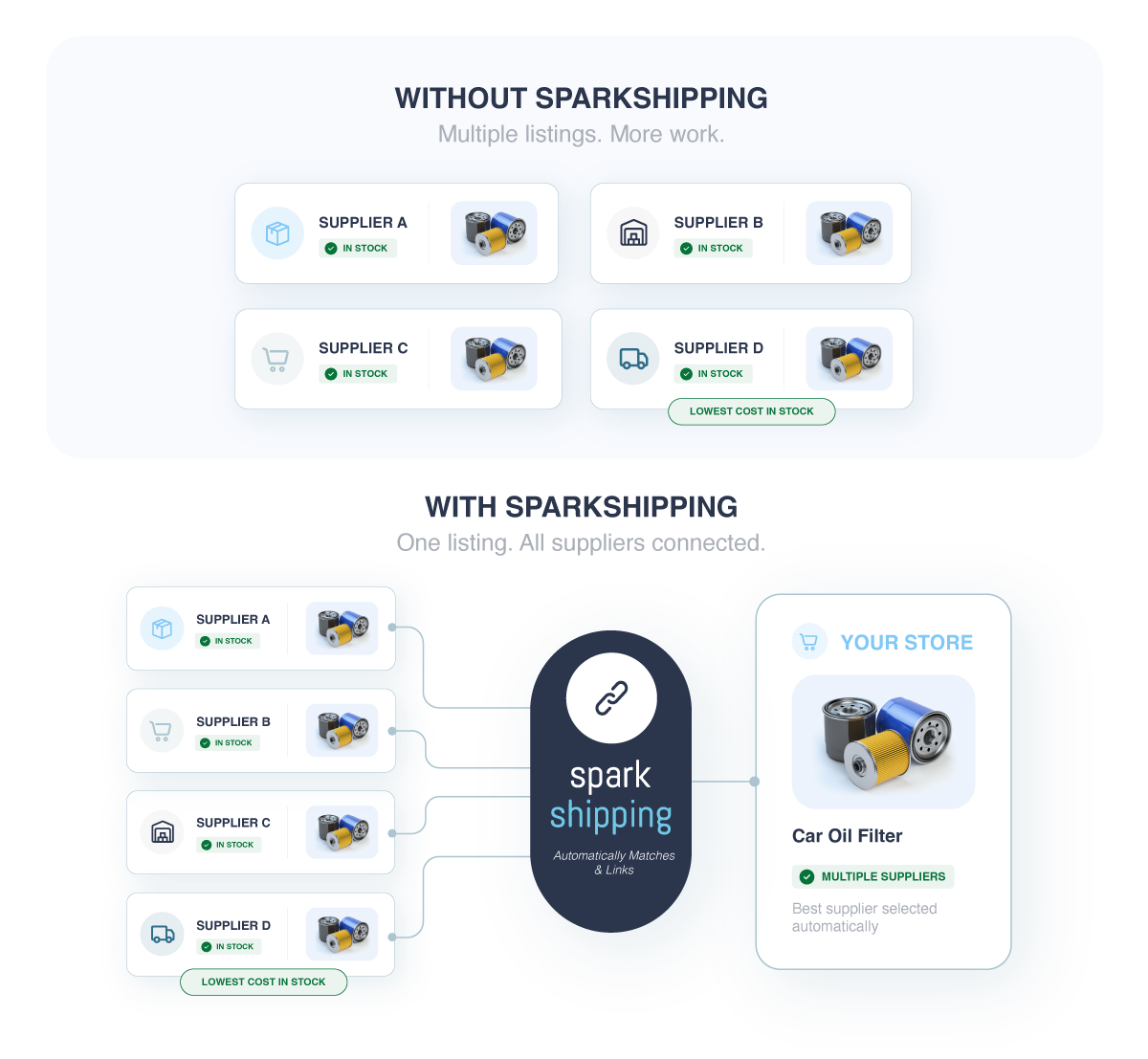
Many ecommerce businesses source the same product from multiple suppliers. However, most ecommerce systems are designed around a one-product, one-supplier model, making these relationships harder to manage as the supplier network grows.

Supplier data varies across catalogs, SKUs rarely align, and inventory and pricing updates become disconnected across systems.

As a result, many businesses end up:

  • Creating duplicate product listings
  • Managing suppliers in spreadsheets
  • Updating inventory and pricing manually
  • Routing orders manually between vendors
  • Relying too heavily on a single supplier

This creates operational overhead that impacts margins, availability, fulfillment speed, and scalability.

02

Centralize Multi-Supplier Product Management 

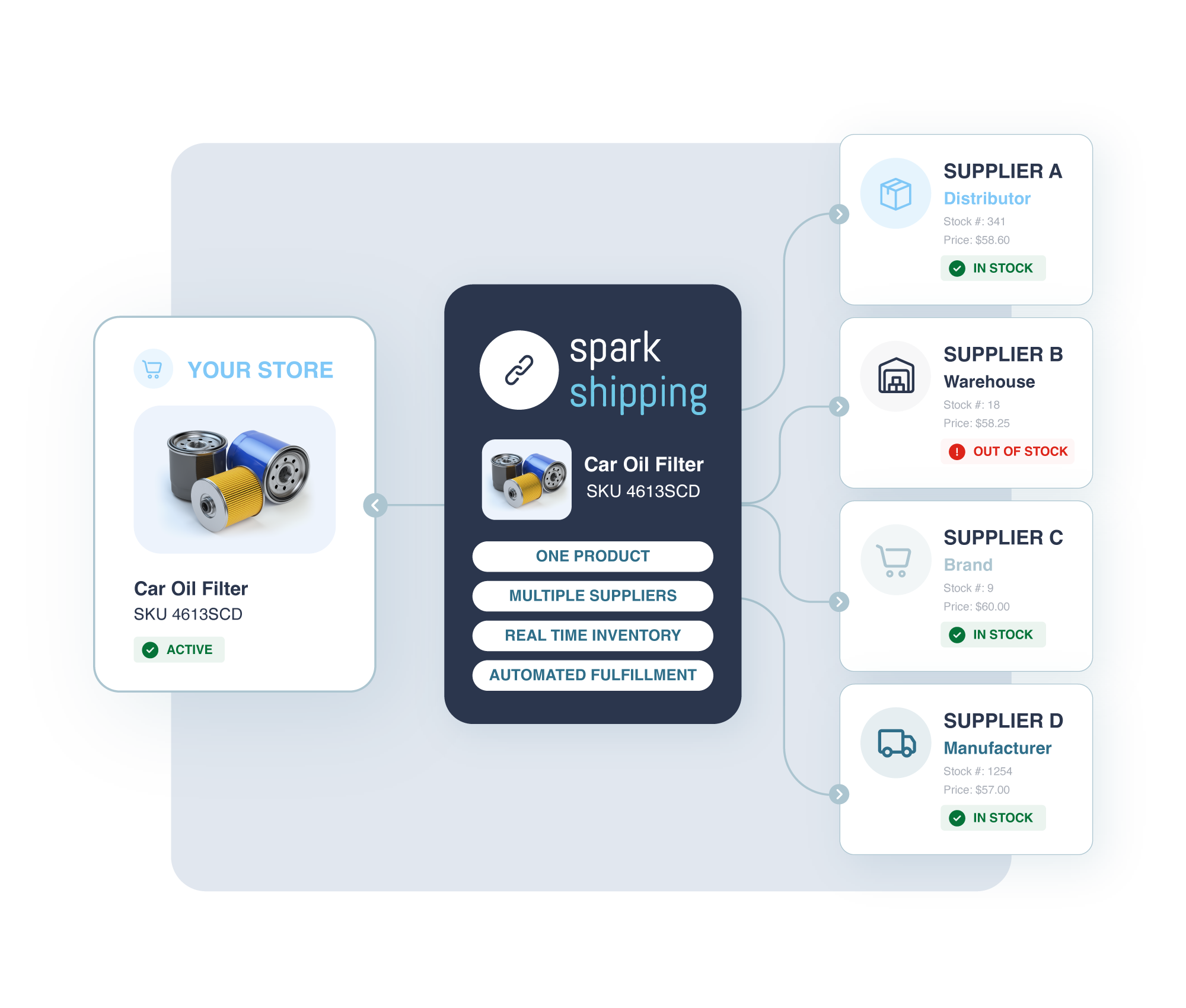
Spark Shipping lets you manage multiple suppliers behind a single storefront product within one centralized operational workflow.


Instead of managing disconnected supplier relationships across multiple systems, Spark Shipping creates a unified system for managing supplier data and fulfillment operations.

transformation 1

Connect multiple suppliers to one product

Manage vendors, distributors, warehouses, and dropshipping suppliers behind a single product listing. 
insight 2

Keep supplier data continuously aligned

Automatically synchronize inventory, pricing, and supplier information as supplier data changes. 
scale 2

Scale multi-supplier operations

Manage large multi-supplier catalogs without creating operational bottlenecks. 

How It Works 

1

1. Connect supplier feeds

Import supplier catalogs, inventory feeds, and pricing data into Spark Shipping. 
2

2. Link suppliers to products

Associate multiple suppliers with the same store product within one centralized catalog. 
3

3. Automate inventory and fulfillment

Automatically synchronize supplier data and fulfillment workflows across connected vendors. 

Intelligent Order Routing Across Suppliers 

Spark Shipping can automatically decide which supplier should fulfill an order based on the rules and priorities you define.
 
This gives you greater control over fulfillment decisions across your supplier network.
 
Routing can be based on supplier cost, inventory availability, warehouse location, shipping speed, and supplier priority.
directions 3

Route orders to the lowest-cost supplier

prioritize 2

Prioritize suppliers with available inventory

warehouse 2

Prefer specific vendors or warehouses

organization (1) 1

Use backup suppliers when stock changes

location 1

Route based on shipping location or speed

Benefits of Automatically Connecting One Product to Multiple Suppliers 

Improve product availability 

Connect multiple suppliers for the same product so orders can continue to flow even when one vendor goes out of stock.

03

Increase sourcing flexibility

Route orders based on supplier cost, inventory availability, shipping speed, or custom business rules.

04

Eliminate duplicate product listings

Maintain one centralized product listing instead of creating separate listings for each supplier.

05

Reduce manual supplier management

Automate inventory syncing, pricing updates, and supplier management across your catalog.

06

Scale large supplier catalogs

Manage thousands of products and suppliers without adding complexity as your catalog grows.

07

Support hybrid fulfillment models

Combine warehouse inventory, distributors, and dropshipping suppliers into a single workflow.

08

Built for Multi-Supplier Ecommerce 

Spark Shipping is designed for ecommerce businesses managing complex supplier networks and growing operational complexity, including:

✔️ Dropshipping businesses working with multiple suppliers

✔️ Distributor-based ecommerce operations

✔️ Hybrid warehouse and supplier fulfillment models

✔️ Large multi-supplier product catalogs

✔️ Teams scaling inventory, pricing, fulfillment, and supplier management

10

Works with Your Existing Stack

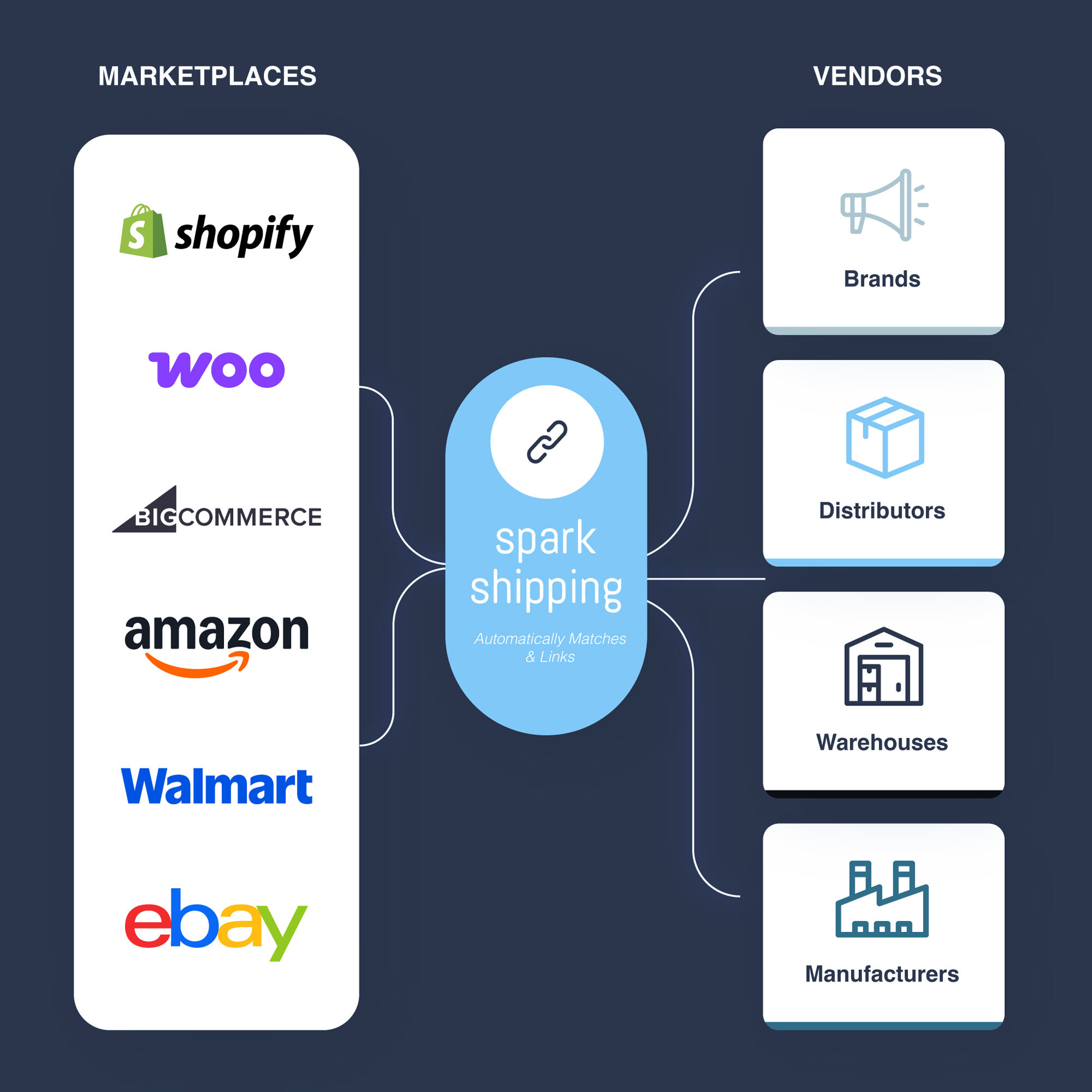
Spark Shipping integrates with the systems you already use, helping you automate operations without rebuilding your ecommerce infrastructure.

SUPPORTS MAJOR PLATFORMS
llink

Supplier integrations

Connect suppliers through API, EDI, FTP, CSV, XML, email-based workflows, and custom integrations. 
LAYER

Multi-supplier operations

Support suppliers, distributors, warehouses, dropshipping vendors, marketplaces, and sales channels within one connected system. 
fitment

Fitment (YMM) tools

Export fitment data in the format required by your preferred Year/Make/Model plugin. 

What Our Customers Have to Say

  • juiced-autoparts star
    "Choosing Spark Shipping was a game-changer... What stood out was their range of pre-existing integrations and their openness to new ones—it never took more than 30 days. This quick integration is quite exceptional in the industry."
    Paul Andrew, CEO
    Read Full Case Study
  • logo_wraith-tactical star
    "Spark Shipping has made my business pretty much run on autopilot... The orders come in, get processed, sent to my suppliers, and the tracking is sent back. I never have to worry about inventory levels.
    Burt Wheeler
    Read Full Case Study
  • logo_bisco-health star
    "The most appealing part was the ability to automate all of my dropship orders. Their help has resulted in a dramatic decrease in the human labor needed to keep our order flow going."
    Sam Fine
    Read Full Case Study
  • logo_ishop-nutrition star
    "We were looking for a company that could do custom API integrations with our dropshippers... Spark Shipping automated and simplified the flow of order, tracking, and inventory data, saving staff hours."
    Read Full Case Study

Frequently Asked Questions 

How can I sell the same ecommerce product from multiple suppliers without creating duplicate listings?

Spark Shipping allows one product in your store to be mapped to multiple vendor SKUs. This lets you manage supplier options behind a single product listing instead of creating separate storefront listings for each supplier. 

Can I connect multiple suppliers to the same product in Spark Shipping?

Yes. Spark Shipping can associate one store product with multiple vendors, distributors, warehouses, or dropshipping suppliers. Each supplier can have its own vendor SKU, inventory data, cost data, and fulfillment setup. 

How do I keep inventory synced when the same product comes from multiple suppliers?

Spark Shipping uses vendor SKU mapping to connect your store product to the correct supplier products. Once those mappings are in place, Spark Shipping can retrieve inventory updates from your suppliers and update your connected store or sales channel based on your configuration. 

How do I automatically choose which supplier fulfills an ecommerce order?

Spark Shipping can route orders based on the rules configured for your store. Routing can use factors such as supplier cost, available stock, vendor priority, warehouse distance, customer location, shipping method, and other supported logic. 

How can I route an order to the supplier with the lowest cost?

Spark Shipping supports lowest-cost routing. When a product is mapped to multiple vendors, Spark Shipping can route the order to the vendor with enough stock and the lowest total cost. If cost or stock data is unavailable, Spark Shipping can use fallback routing logic based on your configuration. 

What happens if my main supplier is out of stock?

If your product is mapped to multiple suppliers, Spark Shipping can use your routing rules to select another available vendor. Depending on your setup, routing can account for stock availability, backorders, supplier priority, warehouse location, and other fulfillment rules. 

Can I prioritize my own warehouse before using outside suppliers?

Yes. If your warehouse or preferred fulfillment source is configured in Spark Shipping, you can use routing rules such as vendor priority, stock checks, and warehouse distance to control when orders should be fulfilled internally or sent to another supplier. 

How do I manage multiple supplier SKUs behind one product listing?

Spark Shipping uses SKU mapping to connect your store product SKU to the corresponding vendor SKUs used by your suppliers. This allows one product listing to stay connected to multiple supplier records for inventory updates, pricing data, and order fulfillment. 

Can I connect suppliers that use different data formats like CSV, XML, FTP, EDI, or API?

Yes. Spark Shipping supports both prebuilt and custom vendor integrations. Suppliers can be connected through formats and methods such as API, HTTP web service, EDI, CSV, XML, FTP, and other integration workflows, depending on how each supplier provides data. 

How can I scale a dropshipping business without having to manage everything manually?

Spark Shipping helps multi-supplier dropshipping businesses centralize product mapping, supplier inventory, pricing data, order routing, and fulfillment workflows. This reduces the need for spreadsheets, duplicate listings, and manual supplier coordination as your catalog and supplier network grow.